

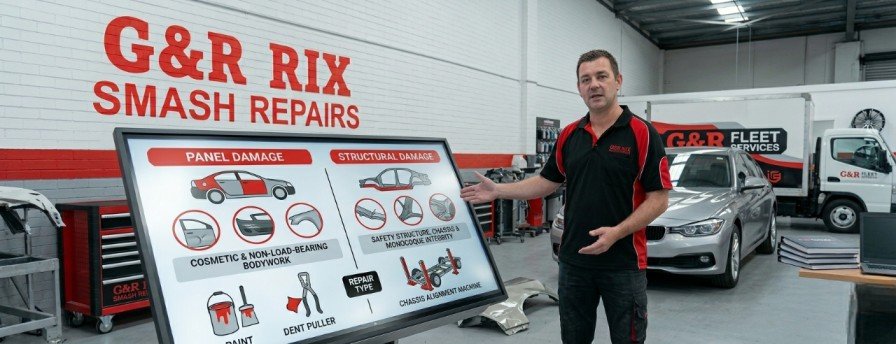
Having a car accident? But can’t you compare panel damage vs structural damage? Not knowing the difference can lead to costly mistakes and safety risks. While it’s natural to focus on visible damage after an accident, like dents, scratches, and damage to the surface. But the most damage is hidden beneath panels and structure. So, you must decide whether a dented door only requires cosmetic repair or hides serious structural issues.
So, today we’ll learn how to spot the difference between panel and structural damage. We will also mention what repairs are essential and when to call a professional.
What Is Panel Damage?
Body panel damage means dents, scratches, or minor imperfections on the legal outer surface of the body panels. Including doors, fenders, bumpers, bonnets, and doors. It does not lead to the core structural issues in your vehicle, but it may affect the appearance. However, professional repair is necessary to avoid rust and corrosion that lowers your car’s resale value. So, it does not compromise your safety, but ignoring panel damage means costly repairs afterwards.
Panel damage car repair options
The following are the common panel damage car repair options.
- Paintless dent repair: An ideal method to repair minor dents, dings, and hail damage where the paint is cracked. Technicians use specialized tools to push the surface back into its original shape from behind.
- Scratch Repair: It involves buffing out the scratch and applying touch-up paint. However, for deep scratches, only professional services can make a difference.
- Bumper Repair: Low-speed impacts cause bumper damage. Extensive damage requires complete replacement, while small cracks can be repaired with plastic welding or adhesive bonding.
- Door Damage Repair: Collision can also result in door damage and panel alignment issues, which require adjusting hinges, latches, or mounting points to restore proper panel fit without replacing parts. In case of severe bending or rust, a full door panel replacement is necessary.
What Is Structural Damage?
Structural damage refers to any damage that affects your vehicle’s structural integrity and framework. It includes damaged crumple zones and impact absorption areas, subframe damage, chassis damage, and frame damage. These damages affect the skeleton of your vehicle, compromising the safety of passengers. Even low-speed car accidents can disrupt these critical components, no matter how minor they seem to be. That’s why visual inspection after an accident is not enough to identify structural issues. Professional damage assessment is necessary even in minor accidents, in which technicians use advanced tools to assess and repair the damage, securing your safety.
Cosmetic damage vs structural damage
Cosmetic damage is limited to surface-level issues, including chipped paint, dings, damaged trim, broken headlights, etc. In contrast, structural damage goes deeper, affecting the underlying framework, invisible to the surface. It includes weakened joints, misaligned mounting points, damaged campus zones, cracked frames, and twisted panels.
Understanding and comparing cosmetic vs. structural damage in cars is important. Because both types of damage in cars need quick professional repairs before they turn into costly repairs or complete replacement. Ignoring cosmetic repairs results in rust, corrosion, insurance claim complications, and decreased resale value. However, ignoring structural repairs means compromised safety hazards, poor handling, misalignment, and system failures.
Panel Damage vs Structural Damage: Key Differences
Repair time
Repair time usually depends on the type of damage, the vehicle, and whether the damage requires repair or replacement. Panel damage usually involves minor scratches, dents, dings, and bumper damage, which takes 3-7 days of repair time. PDR can be completed in 4 to 5 hours, but significant dents can take up to one week. On the other hand, structural repair takes approximately 1 to 2 weeks, depending on the severity of the damage.
Cost Difference
The cost depends on which type of repair the vehicle has, labor hours, and whether parts replacement is required or not. On average, parallel damage usually costs around $500 to $1500. However, panel beaters may charge more than this range in the case of luxury vehicles and OEM parts replacement. However, structural damage repair costs around $5000 to $10,000 to restore vehicle safety standards.
Panel Damage vs Structural Damage: Complexity comparison
Minor scratches are simple to repair, but cracked metal, damage on body lines, and stretched dents are complex to handle. Structural repair complexity comes from vehicle safety systems, alignment, and crashworthiness, including suspension damage after accidents, airbag sensor damage, and impact on absorption areas. That’s why only professionals with proper tools are recommended to ensure your car is safe to drive again.
How Accident Damage Is Assessed
The accident damage assessment process will help repairers and technicians identify the repairs and replacements your vehicle needs. They start with a visual inspection of dents, scratches, and broken parts to note down surface smash repairs after an accident. After that, they move towards detailed collision damage inspection steps. It includes inspecting interior and exterior damage using specialized tools and computerized measuring systems.
After inspection, technicians document all smash repair damage types with detailed notes and photographs. This documentation process is important to claim insurance and present repair estimates, including labor cost and parts cost.
Post-accident inspection checklist essentials
- Prioritize your safety first and pull your car onto the side to prevent blocking traffic.
- Turn on hazard lights for safety purposes.
- Examine the exterior of your vehicle, including body damage, dents, and scratches.
- Look for misalignments and deformations.
- Check all windows and windshields, as even a small crack can lead to safety risks.
- Also, inspect for leakage around the engine, tire punctures, and uneven wear.
- Compare panel damage vs structural damage, document, and take photos of each smash repair’s structural damage for insurance claim purposes.
- Provide accurate details to your insurer to ensure a smooth claim process while restoring your vehicle to its original shape.
Panel Damage vs Structural Damage: Repairable vs Non-Repairable Damage
What makes damage repairable
Damage is considered repairable when it does not affect or compromise the safety of the vehicle, and the affected parts can be restored to their original condition. It includes chassis alignment, minor suspension, frame straightening, and surface damage, including bumper dents and scratches. Also, several factors influence the repairable damage, including the extent of the damage, the cost compared to replacement, and whether repair can fully restore the vehicle’s safety and performance.
When structural damage leads to a write-off
When structural damage makes your vehicle unsafe to drive and when the insurer considers it too costly to repair, it leads to a write-off. This damage could lead to collision, mechanical failure, or even natural causes such as fire. It includes twisted chassis, collapsed crumple zones, or heavily damaged suspension mounts, which affect the safety of your vehicle. Overall, non-repairable damage means the cost or complexity of insurance structural damage repairs exceeds the vehicle value, and the damage cannot be fully restored.
Choosing the Right Collision Repair Service – G&R Rix Smash Repairs
G&R Rix Smash Repairs delivers skilled workmanship using specialized tools and equipment to deliver high-quality solutions to collision repair in Liverpool. From panel beating service to car repair, structural fixes, and complex replacement, our experienced team simplifies the repair process while maintaining precision and reliability. Our professional smash repair evaluation accurately assesses and documents all damages, ensuring the repair not only restores appearance but also structural safety standards.
Frequently Asked Questions
Q1: What is the difference between panel damage and structural damage?
Panel damage only covers exterior-level issues, including dents, scratches, cracked paint, and damaged doors and fenders that do not affect safety. However, structural damage means an effect on the vehicle’s structural integrity, including frame, chassis, and suspension damage. It also includes panel alignment and handling issues that need professional repairs.
Q2: Is panel damage only cosmetic?
No. Panel damage not only affects cosmetics. Minor scratches and dents only affect appearance, but deep scratches may hide structural issues like damaged absorbers, misaligned doors, and bent supports. So, professional inspection is necessary even if the damage looks cosmetic.
Q3: What counts as structural damage in a car accident?
Structural damage in a car means the harm affecting the vehicle’s core framework, including body panels, subframe, safety system calibration, and suspension mounting points. These damages affect the structural integrity of your vehicle, making it unsafe to drive.
Q4: Can a car be safe with structural damage?
A car is not considered safe at all with unrepaired structural damage. It not only compromises the frame integrity, crumple zone, and airbag deployment but also endangers your life. Because severe damage leads to poor handling and system failures, which may result in car collisions or crashes.
Q5: How do I know if my damage is structural?
The following signs, from which you can identify your damage, are structural.
- Panel gaps and panel alignment issues
- Weird noises and bumps while driving
- Uneven tire wear
- Visible bends
- Cracks in the undercarriage frame rails
Q6: Does insurance treat panel and structural damage differently?
Yes, insurance companies treat panel and structural damage differently. For panel damage after an accident, they use straightforward processes such as replacing door panels, fixing bumpers, and removing scratches and dents. However, structural damage required complex processes to ensure precise repair while maintaining safety standards.
Q7: Can minor accidents cause structural damage?
Yes. Minor accidents cause structural damage in cars, such as frame, suspension, and internal component damage. Modern vehicles also have sensitive sensors and cameras that can easily damage low-impact vehicles. These hidden damages cause airbags and absorption zone issues.
Q8: Is structural damage repairable?
Whether the structural damage is repairable or not depends on the severity of the damage, the repair method, and the type of vehicle. However, if the insurer notices that repairing exceeds the value of the vehicle, then it may consider it as repairable damage.
Q9: Does structural damage affect resale value?
Yes. Structural damage from a car accident significantly reduces your vehicle’s resale value. Structural problems affect the safety of the vehicle, which leads to long-term diminished value. So, professional repair is important to restore not only your vehicle’s safety but also its resale value.
Q10: Where can I get accident damage assessed in Liverpool?
You can get professional accident damage assessed in Liverpool at G&R Rix Smash Repairs. Our team ensures precision at every step, from car accident damage assessment to restoring the car’s overall safety and appearance.
Conclusion
All in all, understanding the difference between panel damage and structural damage helps to give the right repair to your vehicle. Ignoring this damage can lead to safety risks and costly repairs later. However, both accident damage types require professional care and attention to detail to bring your vehicle back into its original condition. So, comparing panel damage vs structural damage ensures when to choose a quick fix with confidence.